Comparison between different capacities
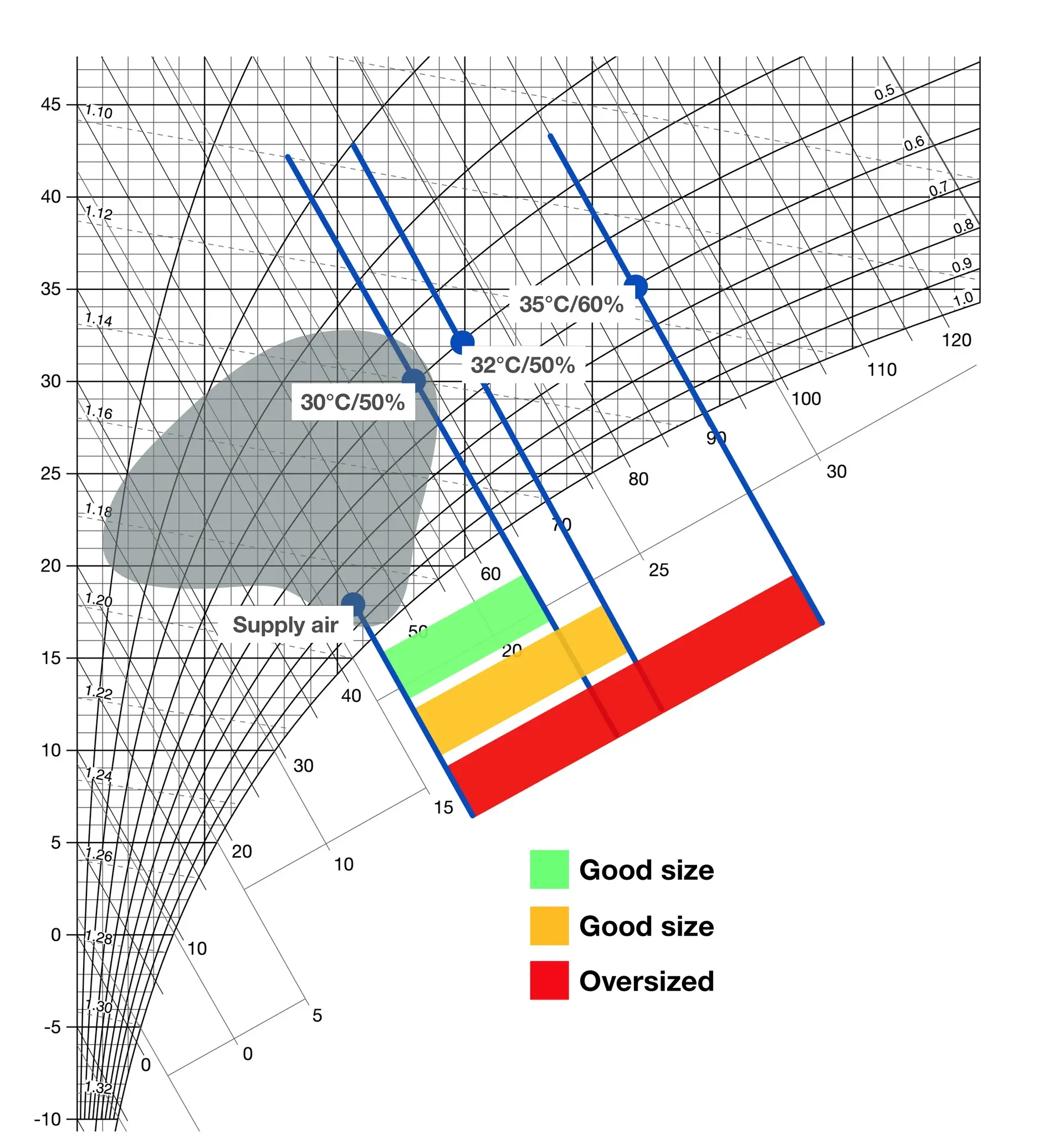
The grey area represents the most common temperatures and relative humidity over a summer.
The diagram shows three different output levels that are compared to each other to indicate how much energy is required to reach a supply air temperature of 18°C for the different values.
35°C/60% falls far outside the grey area, indicating that this state rarely occurs. This means that it is unnecessary to have overly high cooling capacity because the unit becomes too large and costly. 30°C/50% is sufficient to cover the cooling needs on most days. Although there will be a few days that fall outside the cooling capacity, the unit will still deliver a good power while maintaining good control functionality throughout the cooling season.
At 30°C/50% or 32°C/50%, the cooling capacity is appropriately sized in this case and still has good capacity for the hottest days. This results in an air handling unit that is energy efficient, cost-effective and reliable with good control functionality
Note: While air handling units with integrated cooling in warmer climates are sized to deal with higher temperatures, they still adhere to the same principle as above.